How to Find the Way of Investing That Actually Fits You
The most-argued question in investing is also the wrong one. Stocks, value, trading, crypto — everyone’s fighting over which approach is best. And they’re all missing something more useful: the best approach on earth is worthless if it isn’t the one you can hold onto when the screen turns red.
This post walks through two of the most proven, most opposite ways to invest — value investing and a rules-based (tactical) approach — with the honest pros and cons of each, and three simple questions you can use to figure out which one actually fits you. If you’d rather watch than read, the 12-minute video above covers the same ground.
My mistake — panic-selling at the COVID bottom
A few years ago, before COVID, I tried to invest the way the famous value investors do. Buy a handful of “great companies”, hold them for the long run. It felt smart. Grown-up, even.
Then COVID hit. The market fell off a cliff. And I realised something uncomfortable: I didn’t actually understand these companies well enough to know if they’d make it through what looked like the end of normal life. I got scared. And I sold — right near the bottom. The single worst possible moment to sell.
That mistake hurt. But it taught me the single most important lesson I know about investing: the problem wasn’t that value investing is bad. It’s one of the most proven approaches out there. The problem was that it didn’t fit me. When the moment that actually mattered arrived, I couldn’t hold on. That’s the deeper cost of the wrong approach — not the loss on the way down, but the version of you that shows up in the worst moment. There’s a broader piece on that dynamic in why panic selling is the real risk; this post is my own version of the same story.
The one question that actually matters
When I started out, I thought the important question was which strategy makes the most money? That’s the wrong question. Chasing it is exactly how I ended up selling at the bottom.
The real question is quieter, and much more useful:
Which way of investing can I actually stick with — when everything is falling apart?
Any plan looks great on a calm Sunday afternoon. The real test is Monday morning, when the screen is red and your gut is screaming at you to get out.
And here’s the honest part most beginner content skips over: a good method really does make you money — that part is true. But only if you stay in it. And you’ll only stay in a method that actually fits who you are. Pick one that doesn’t, and you’ll bail at the worst possible moment. Like I did. So really, this whole post is about one thing: helping you find the way that fits you.
A quick gut check
Before we go deeper, one thing you can use in the next ten seconds.
Picture this. Tomorrow morning, the market drops 50%. Everything you own — way down. Really sit with that for a second.
Does part of you get a little… excited? Like — finally, good stuff on sale? Or does your stomach drop and you just want it to stop?
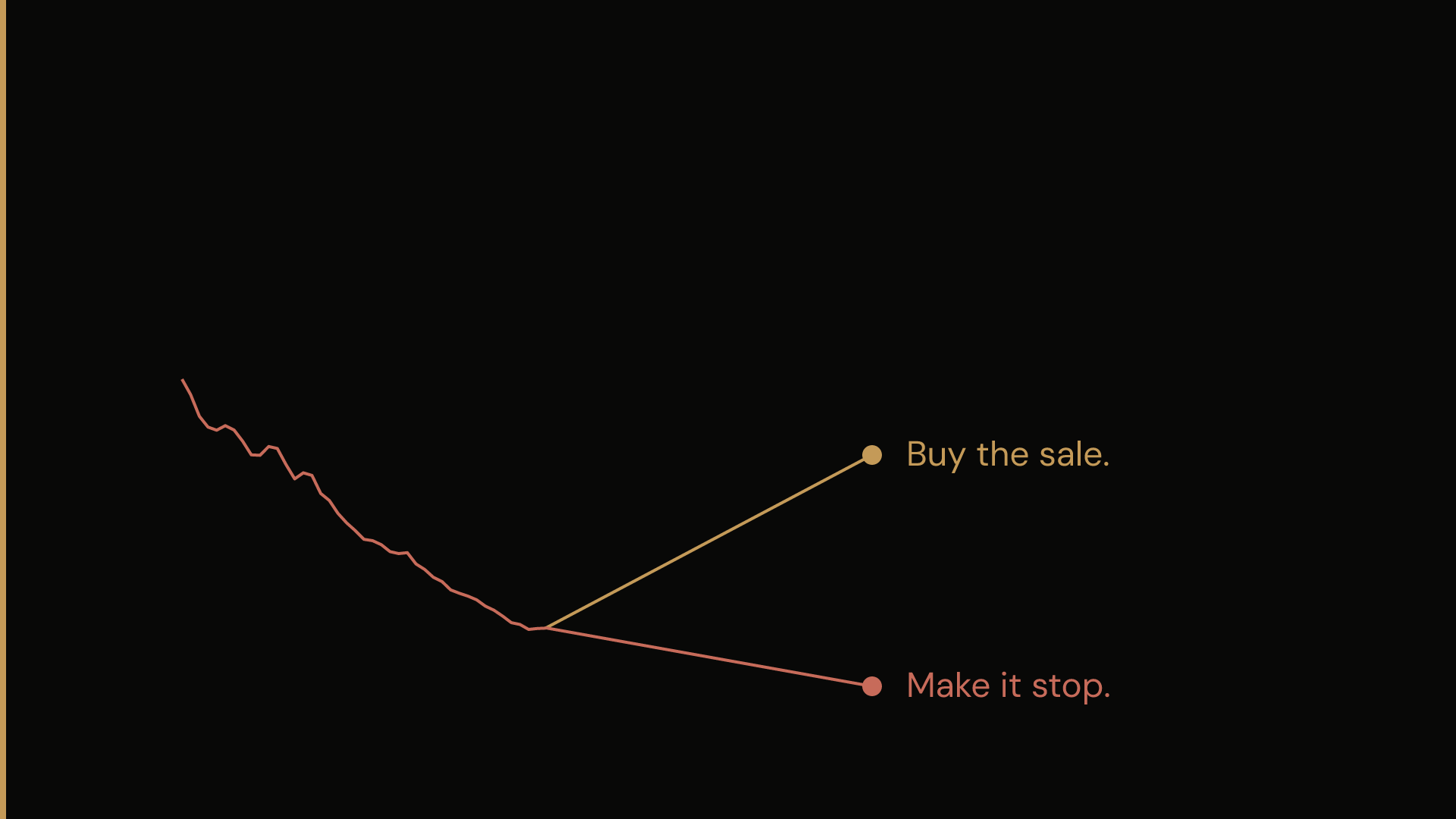
There’s no right answer. But that gut reaction already tells you which way you lean. Hold on to that feeling. In a few sections, I’ll turn it into three simple questions that pin down exactly what fits you.
The simplest honest answer first
Before we get to the two paths, an honest side-note — because for a lot of people, the simplest option really is the right one.
If you don’t have much time, you don’t want the hassle, your goal is just to beat inflation over the long run, and you’re honestly sure you can stay calm and hold through a big crash — then a cheap, broad index fund, bought every month and held for years, is a great choice. No shame in that at all. It’s boring, and it works.
But maybe you want more. More control over how much you could lose. Or you actually want to beat the market — not just match it. Then you need a real method. There are many out there — currencies, crypto, options, futures, and more. I’m going to focus on the two I’ve personally tested for years, and honestly, the two that make the most sense for regular retail investors like you and me. They’re both proven, and they’re complete opposites.
Path A — Value investing
The first path is business-first. You’re not buying a ticker symbol; you’re buying a piece of a real company.
So your focus is the business itself. Does it make good, reliable money? Is it built to last? The price tag isn’t really the point — it’s just your timing. You wait, patiently, to buy a great company when it’s on sale.
The cost: you have to genuinely understand businesses. That means a lot of reading — annual reports, industry research, financials — and patience measured in years, not weeks.
The reward: when the market crashes, a great company you understand just went on sale. A 50% drop isn’t scary — it’s a discount. You can actually be happy about it, and buy more.
If this path speaks to you, the honest advice is: stay inside your circle of competence — only businesses you truly understand — and get really comfortable reading how a company makes its money, and whether its finances are solid. That’s the whole edge. Nothing else is a shortcut.
Path B — Rules-based (tactical) investing
The second path is numbers-first. This is my camp.
Here, you don’t try to know every business inside-out. Instead, you try to understand what the market as a whole is doing — and turn that into something measurable, something you can actually act on. Clear rules, based on the market itself.
You move with the market’s direction: lean in when it’s healthy, step back when it turns down. Your main goal isn’t the highest possible return — it’s smaller crashes along the way. And that matters more than it sounds. When you’re not clawing back from a 50% hole every few years, your good years get to compound. Protecting your downside is one of the most underrated paths to strong long-term returns; the maths of drawdowns compounds ruthlessly.
The big idea: you don’t predict the future. You decide, in advance and on a calm day, exactly how you’ll react when the market changes — and then you just follow your own rules.
The cost: discipline. You build your rules on a calm day, and then you actually have to follow them on a scary one.
The reward: when a crash comes, you already have a plan. You know exactly what to do. Smaller losses, less to stomach, and you sleep at night.
Is the system perfect? No. Sometimes you get faked out — the market dips, your rule pulls you out, then it bounces right back without you. That’s real, and it’s annoying. But you live with those small misses, because the payoff is worth it: you sidestep the crashes that actually do the damage. The full honest comparison between rules-based investing and just buying-and-holding is in buy-and-hold vs tactical investing — when each wins.
What both paths quietly share
On the surface, these two paths look nothing alike. One studies businesses; the other follows rules. That difference is obvious.
But here is what surprised me. Underneath, both winners share two things.
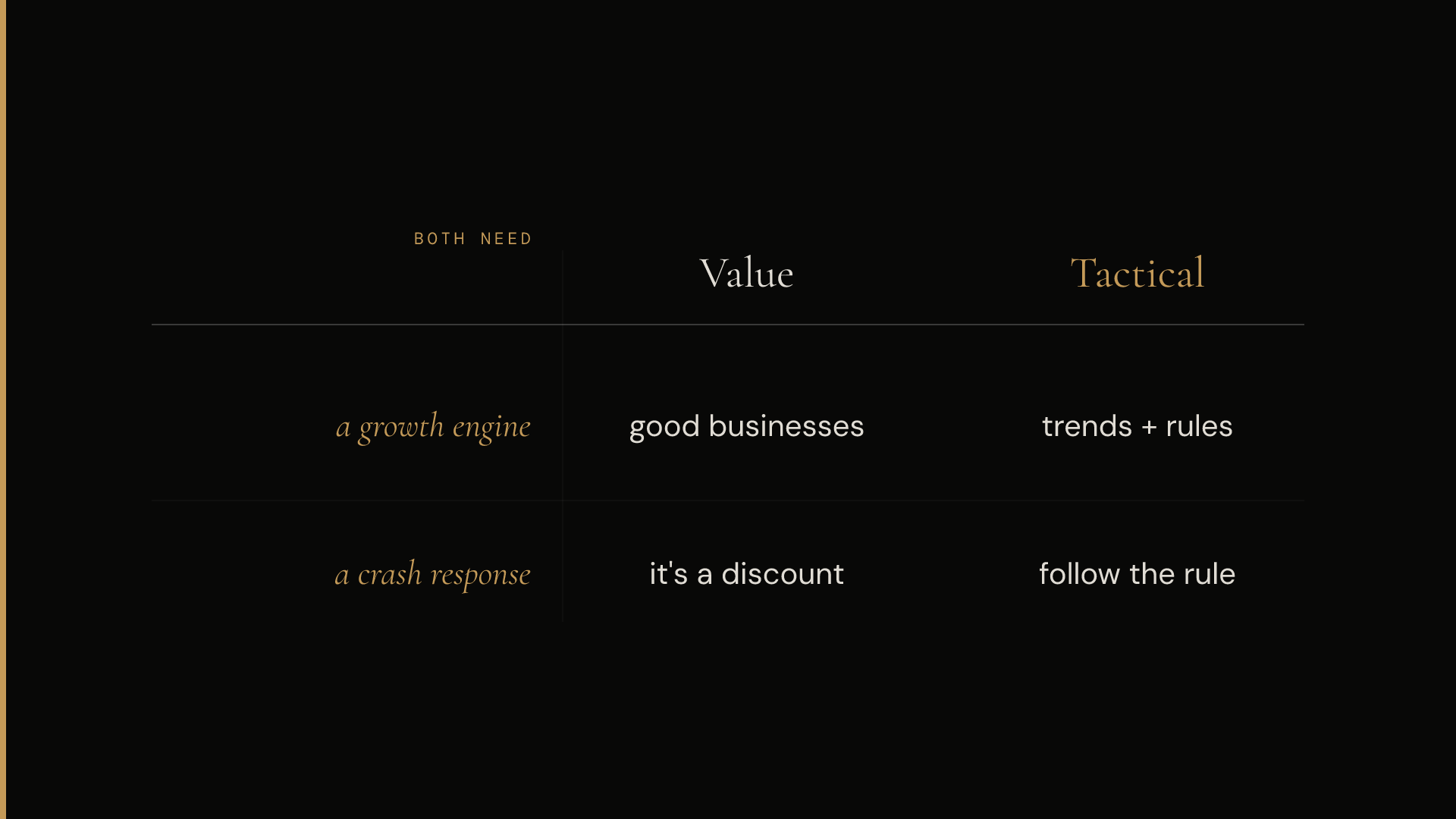
First: each one has a clear engine for how it actually grows your money. It’s not hoping, and it’s not vibes — it’s a plan.
And second — this is the big one — both take the emotion out of the crash. Value does it by seeing the drop as a discount. Tactical does it with a rule you set in advance, so panic never gets a vote. Almost everything else people argue about online matters far less than these two things.
Three questions to find your fit
Remember your gut reaction to the 50% drop from a few sections back? Let’s turn it into your answer. Three honest questions. There are no wrong ones.
Q1 — What would you actually enjoy? Digging into companies, reading how a business really works? Or building a simple system, and following clear rules? Whatever you’d genuinely keep doing for years — that’s the one you’ll stick with.
Q2 — In a crash, what do you need? To be able to buy the dip and feel fine — that’s value. Or to have your losses be smaller so you stay calm — that’s tactical. That’s your gut check from earlier, now made explicit.
Q3 — When it’s time to act, what do you trust more? Your own read on a specific company, in the middle of a panic? Or a clear rule you set back when you were calm, and thinking straight?
Be really honest with yourself here. That honesty is the whole edge — it’s the exact thing I got wrong the first time.
My own answer — and where it took me
For me, the answers were obvious in hindsight — I had just learned them the hard way. I don’t love digging through company reports. I don’t fully trust my own judgment in the middle of a panic. And I care far more about avoiding a brutal crash than squeezing out the last little bit of return.
That puts me firmly in the tactical camp. After COVID I made myself a promise: never again would panic make my decisions for me. So I built a system — a set of rules that reacts to how much fear is actually priced into the market at any given moment. The Tactical Investing Fear Index is the gauge those rules read from: the more fear the market is pricing in, the higher it climbs. My rules react to where it sits — calm, elevated, or full stress — not to my mood.
If Path B fits you too, three next reads cover the practical side without pretending it’s easy:
- How to build your first strategy in PortfolioLab — the step-by-step for getting a single rules-based strategy into place
- Three example strategies for different risk profiles — worked-through examples across Conservative, Balanced, and Aggressive designs
- Combining strategies into a portfolio — because no single strategy is guaranteed to keep working forever, and combining a few is how you stay ready for more than one possible future
The takeaway
Whichever path you pick, the worst possible choice is not having a method at all. That’s the version of investing that ends with selling at the bottom — the version I lived once, and don’t want to live again.
Your method isn’t ever really done. You keep refining it as you learn about markets and about yourself. But it starts with one honest choice: which way fits you. Not which way makes the most on paper, not which way sounds most sophisticated at dinner — which way you can actually stick with when the screen turns red.
That’s the whole thing. Everything after it is details.
Try it yourself — free: the strategy tester and the weekly Fear Index are both free to use. Take an idea — value-based or rules-based, doesn’t matter — and test it against real market history. See for yourself what it would have done, before you ever have to trust it with real money.
For educational purposes only — not financial advice.