How to Build Your First Strategy in PortfolioLab
Rule-based investing sounds great in theory — and then you log in for the first time and the screen has tabs you don’t recognise, fields you don’t know how to fill, and a backtest button that you’re not sure you should press. This post is the short version of how to go from a blank account to your first working strategy in PortfolioLab, without overthinking it. The goal isn’t to build something perfect on day one. The goal is to get something honest in front of you, so you can see how rule-based investing actually behaves.
If you haven’t read the why first, the short version is in our posts on panic selling and on buy-and-hold vs tactical investing — this one is the how.
Step 1 — Decide what your first strategy is for
Before clicking anything, write down — on paper, in a note, anywhere — what this first strategy is supposed to do. Not a forecast. A job. A few honest examples:
- Stay invested in stocks most of the time, but reduce exposure when market stress is unusually high.
- Hold a single broad equity ETF in calm conditions, and rotate part of the allocation to cash or treasuries when the Fear Index moves into the elevated zones.
- Hold a 60/40 mix in normal conditions, and shift the equity sleeve to a defensive ETF when stress signals fire.
Any of those is a fine first goal. Pick one. The job of the rule is to give your portfolio a pre-decided response to a future moment of fear — not to make every trade perfect. If you can write the goal in one sentence, you’re ready to build it.
Step 2 — Open the Build Strategies tab
In PortfolioLab, strategies and portfolios are two different things. A strategy is a single rule-set: which ETFs to hold and in what proportions in each market zone. A portfolio is one or more strategies stitched together with weights. You’ll start with one strategy.
Open the Build Strategies tab from the sidebar. This is the sandbox — nothing here goes live, you can experiment freely. Click New strategy and give it a name you’ll recognise later (“Equity with stress hedge” beats “Strategy 1”).

Step 3 — Choose your universe (which ETFs you’ll actually hold)
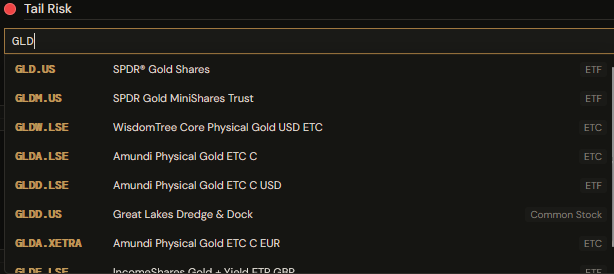
Keep your first universe small. Two or three ETFs is plenty. A simple starting set might be a broad equity ETF (S&P 500 or world index), a defensive asset (long-duration treasuries, gold, or short-term bonds), and cash. Use the ticker search to find them — PortfolioLab supports US and European listings in the format the platform uses (e.g. SPY.US, EXH9.XETRA).
Resist the urge to add ten things to your first strategy. More tickers doesn’t mean more diversification; it usually means more places for something subtle to go wrong. You can always add later.
Step 4 — Define your zones using the Fear Index
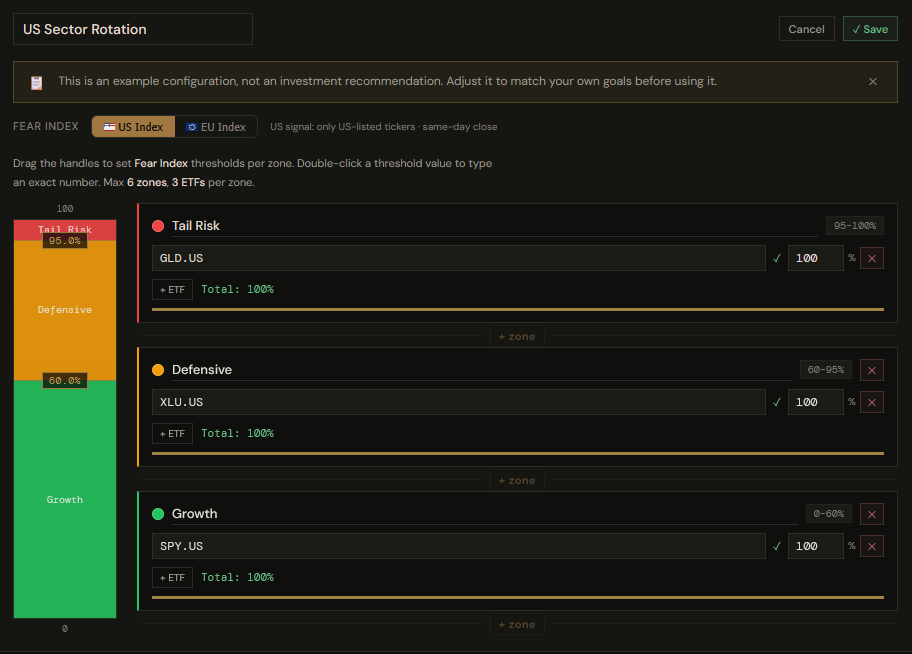
This is the part that makes a strategy rule-based. The Tactical Investing Fear Index runs from low (calm) to high (crisis), and you decide how to slice that range into zones — and what your portfolio should hold in each one. PortfolioLab does not force a fixed number of zones on you. You can use two, four, or as many as you want; you choose the thresholds, the names and the allocations. When the Fear Index moves across one of your thresholds, your strategy shifts to that zone’s weights. That’s it. There’s no forecasting, no judgement call in the moment.
A reasonable first cut for the example above (equity with stress hedge) — using three zones for illustration:
- Calm — 100% equity ETF. The market is quiet; you want full exposure.
- Defensive — 100% defensive. You’re deliberately reducing drawdown risk.
- Tail Risk — 100% hedge (or 100% cash). You either try to benefit from the worst conditions, or you sit on the sidelines on purpose.
Those numbers aren’t “the right answer” — they’re a sensible starting point. The right answer depends on your goal from Step 1, and on what you can actually live with through a real drawdown. A strategy you’d abandon mid-stress isn’t a strategy; it’s a wishlist.
Step 5 — Run your first backtest
Hit Backtest. The platform replays the strategy over historical data: every day, it checks which zone the Fear Index was in, applies the weights you set, and tracks what your portfolio would have done. A backtest isn’t a promise — past behaviour doesn’t determine future returns — but it tells you something honest: how would this rule-set have behaved through the cycles we already know about? Before you interpret the output, it’s worth reading what a backtest actually shows and how to read it honestly — the order in which you read the numbers matters more than most people realise.
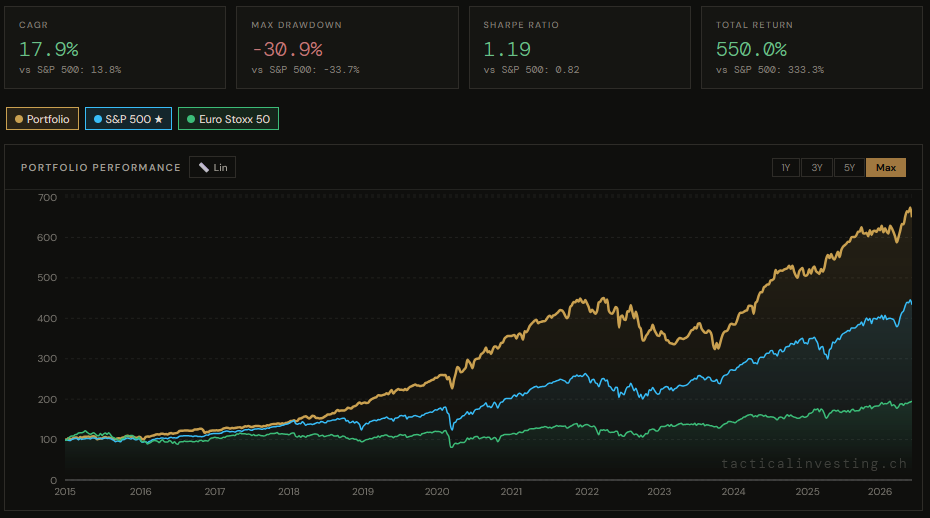
Look at three things before anything else:
- Maximum drawdown — the deepest peak-to-trough loss. This is the number that tells you whether you’d actually hold this strategy when it gets bad.
- Behaviour in known crisis periods. Did the strategy do what you wanted — reduce exposure when fear spiked — or did it sit through the drop? It’s also worth being honest about the limits here: the Fear Index is not a magic tool, and even professional hedgers occasionally call it wrong (2022 was a good reminder). Over long horizons the signal works; judge the strategy across full cycles, not single calendar years.
- Return relative to buy-and-hold. Sometimes tactical wins on return and risk; sometimes it gives up some upside to cut drawdowns. Both can be valid outcomes, depending on what you set out to do.
If the maximum drawdown is more than you’d genuinely tolerate, change the weights — reduce equity in the higher-stress zones — and run it again. This iteration is the work. You’re not trying to maximise return in a spreadsheet; you’re trying to find the rule-set you’d actually execute for years.
Step 6 — Save it, paper-trade it, and only then commit real capital
Once a strategy looks reasonable, save it. You don’t need to commit it live yet. Come back to it in a few days with fresh eyes — maybe you’ve had an alternative idea in the meantime you’d like to test. Many of the best decisions in rule-based investing are the ones you didn’t make today.
Before any real money goes in, paper-trade the strategy first. Follow the signals on paper for a few weeks or months: watch how the zone changes feel, how often it asks you to act, whether you actually do what the rule says when stress rises. Paper trading is cheap, honest practice. Going from a clean backtest straight to live capital skips the most useful part of the process — finding out whether you can run the strategy, not just whether the strategy is sound.
When the paper run feels right, you’ll add the strategy to a portfolio and start following its signals for real — but that’s a topic for another post. For now, the win is having a written, testable, pre-agreed response to fear. That alone puts you ahead of most retail investors, who only decide what to do when they’re already in the middle of a drop.
What to do next
Your first strategy doesn’t need to be brilliant. It needs to exist. Once it’s in place, you have something to argue with — refine the weights, try a different defensive asset, build a second strategy and blend the two. The platform is built to let you iterate without anything going live until you choose to.
If you haven’t yet thought through whether a tactical approach is even the right fit, the buy-and-hold vs tactical comparison is the post to read next. If you want to understand what the Fear Index is actually measuring before you put weights against it, the fear index explainer covers that. If your defensive sleeve might involve a hedge, when hedging actually pays off walks through what genuinely works and what just costs returns. If you want to see three worked examples — conservative, balanced, aggressive — with real backtests, three example strategies for different risk profiles gives you the concrete shapes. When you’re ready to run more than one strategy at once, combining strategies into a portfolio covers what a blend actually delivers and how to keep the diversification honest. And if you want the deeper reason any of this matters — why a rule beats willpower when it’s getting hard — that’s panic selling, the real risk.
For educational purposes only — not financial advice.