I Tested 5,386 ETFs for a Safe Haven. 87% Failed.
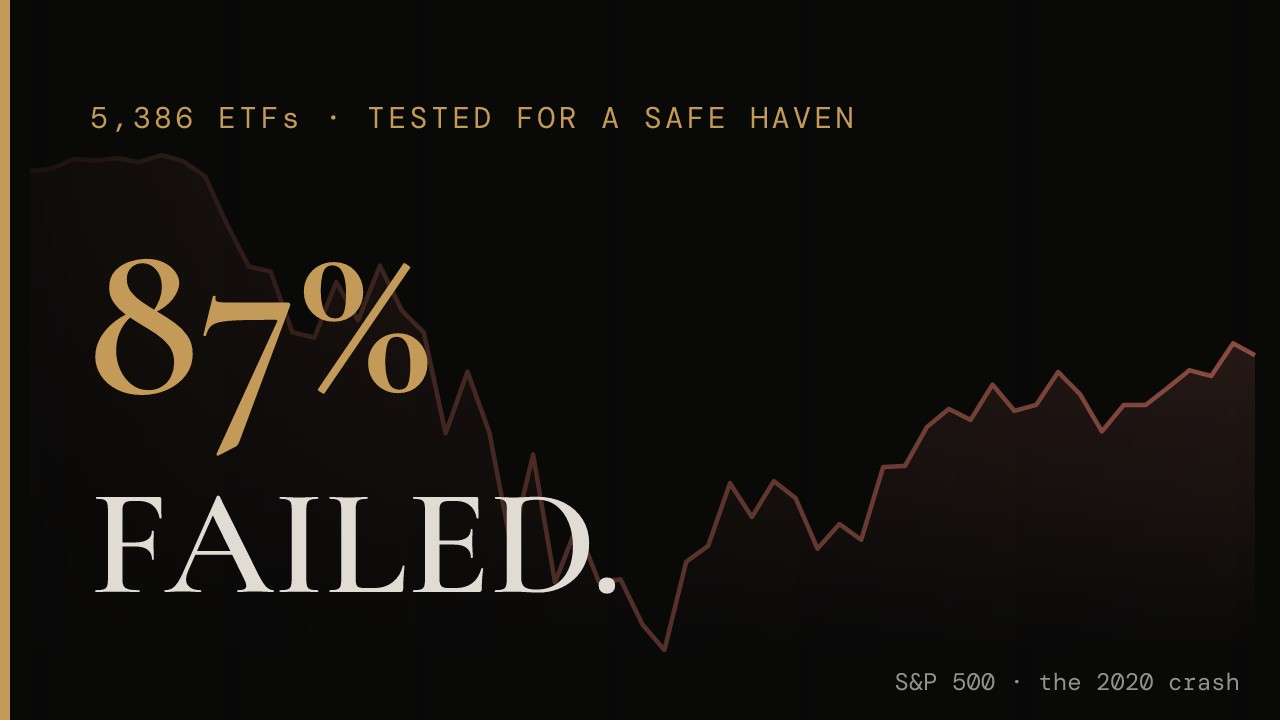
When markets crash, everyone repeats the same advice: run to a safe haven. Gold, bonds, cash. So I stopped nodding along and actually checked — every U.S. fund I could get, through every crash of the last fifteen years. Most of them didn’t protect you at all. This is the written companion to the video.
It sounds obvious — which is exactly why almost nobody checks it. I did something dull and slightly obsessive instead: I took a single rule, pointed it at thousands of funds, and made a computer run the same test on every one of them, through seven real market crashes.
The result was brutal. Of every fund with a full crash record, only about one in eight actually rose when stocks fell. The other seven-eighths — the ones sold to you as ballast for the bad days — mostly sank right along with the market.
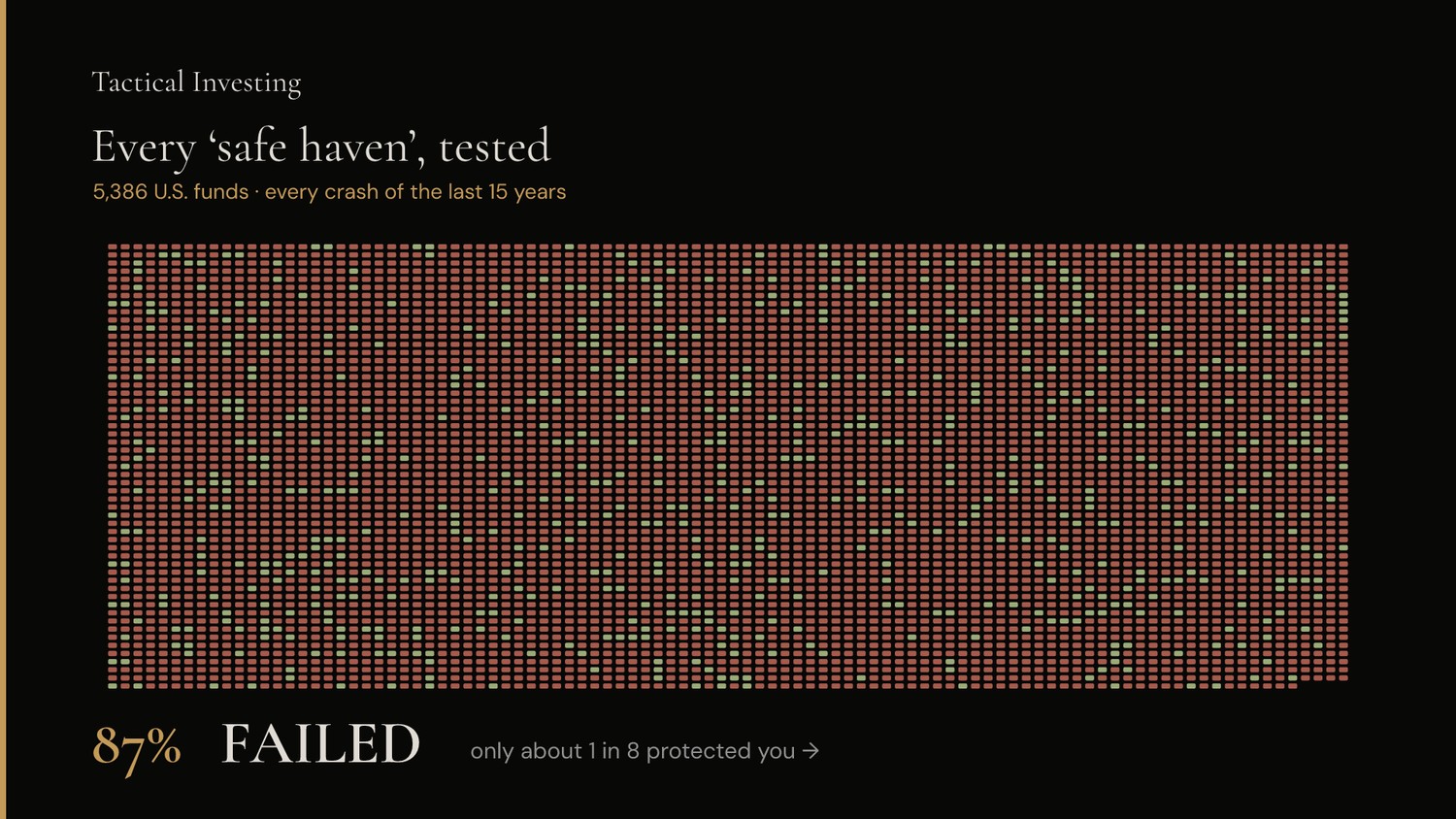
Most of them were never really havens
Now, a fair objection: most of those funds are just baskets of stocks. Of course they drop when the market drops — that isn’t a failed haven, it’s a stock fund doing its job.
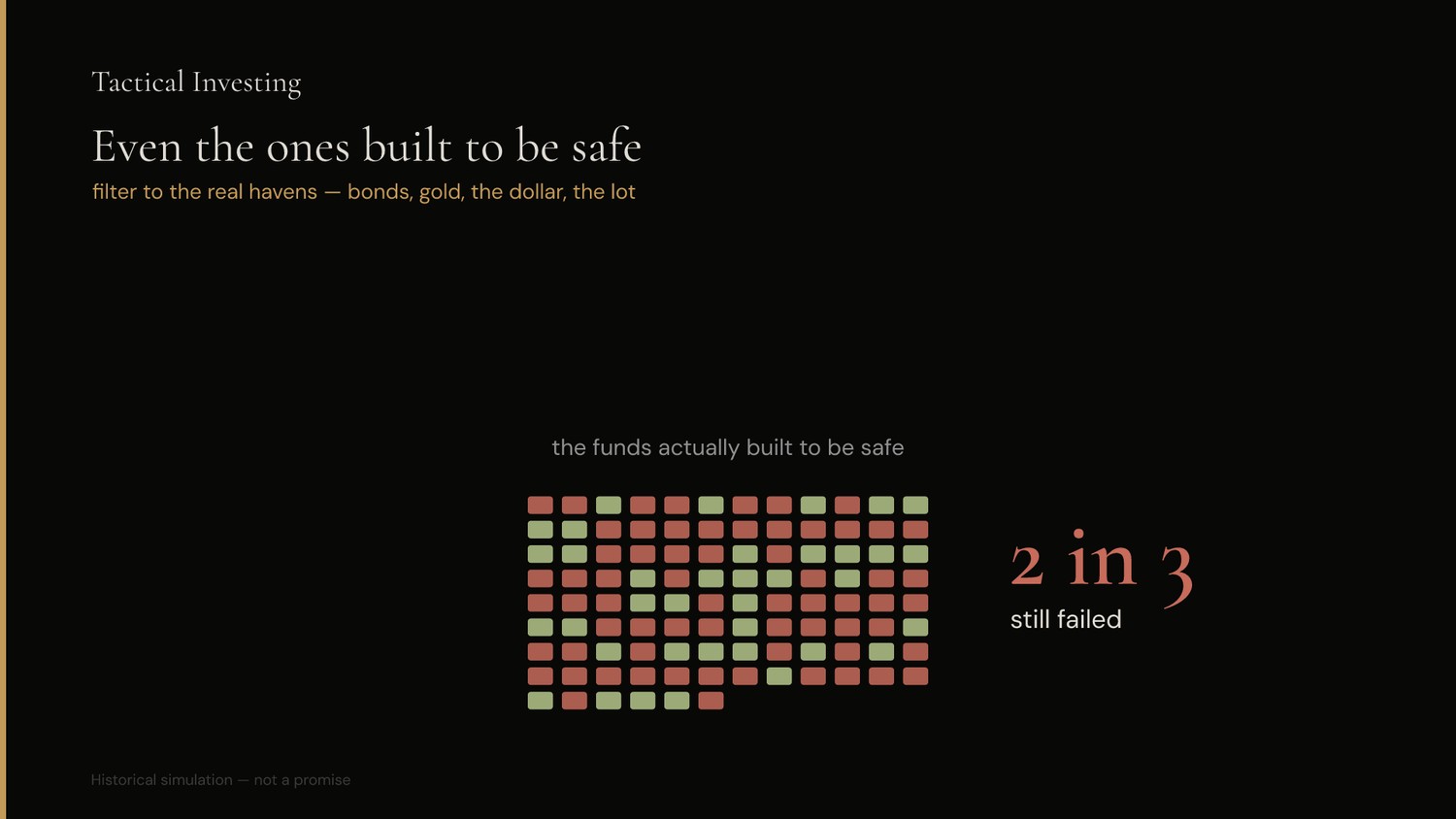
So I zoomed in on the ones actually built to be safe — the bonds, the gold, the “low-volatility” funds, managed futures, the dollar, the lot. Roughly a hundred genuine candidates. And here’s the uncomfortable part:
Even among the funds designed to be safe, nearly two out of three still failed.
The word “safe” on the label, it turns out, meant almost nothing. That’s the number that made me keep digging.
One simple rule, run on everything
I didn’t want opinions. I wanted one rule, applied the same way to every fund, so the results couldn’t be cherry-picked.
The rule watches a single thing — a fear gauge. When markets are calm, you stay in stocks. When fear spikes to the extreme, you swap out of stocks and into a haven. That’s the whole strategy. No forecasting, no gut calls.
Then I varied the haven — gold, government bonds, cash, emerging markets, managed futures, dozens of them — and ran that exact same test on every fund, through all seven major crashes since 2011. Thousands of runs, one honest yardstick.
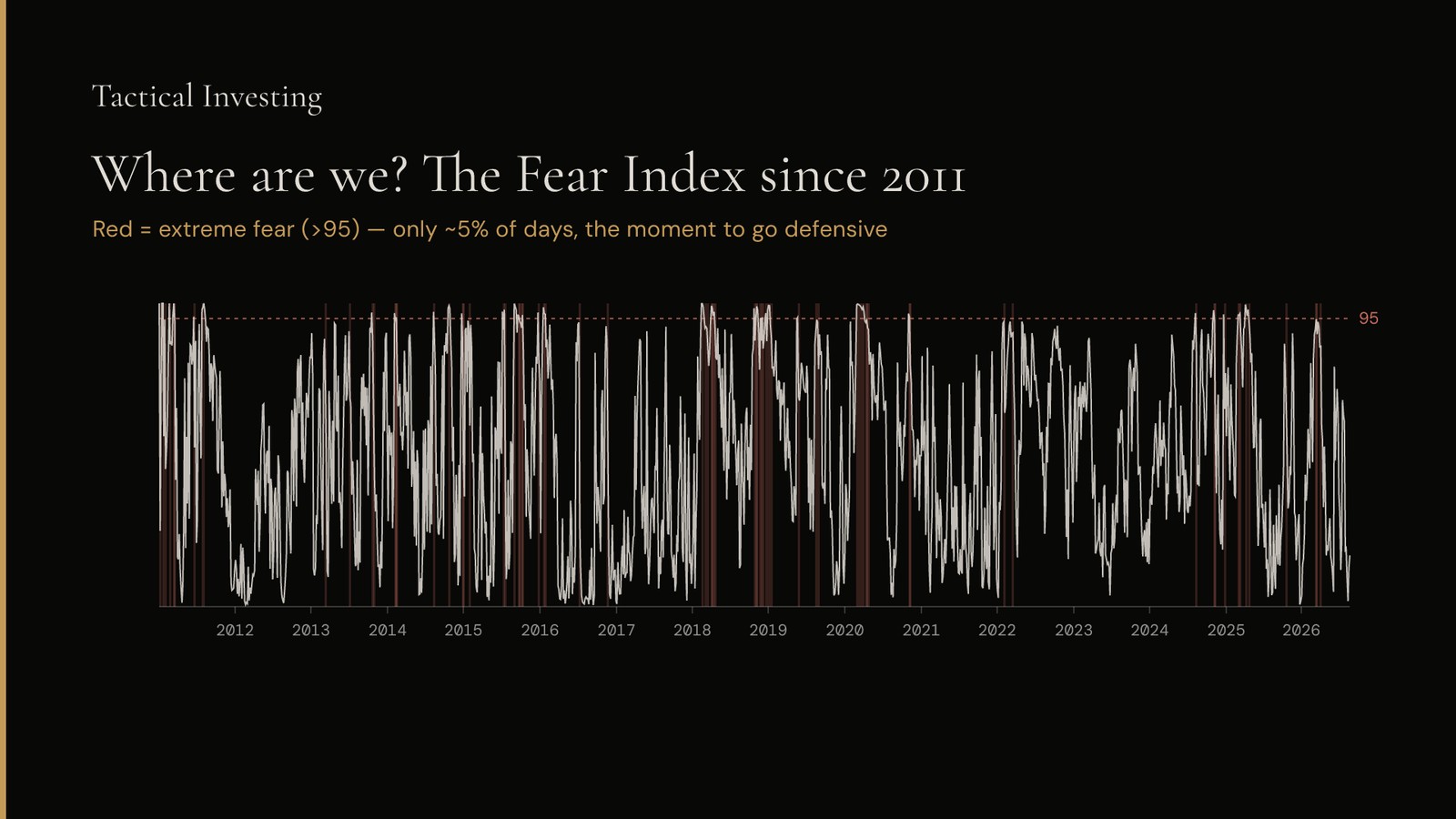
The Fear Index, 2011–today. It climbs above 95 — extreme fear — on only about 5% of days (the red marks). Those rare days are the only ones this test ever acts on.
The damage you’re trying to avoid
Before naming winners, you need an enemy. So I looked only at the moments when fear was at its very highest — the real storms — and measured what the market itself did in just those windows. Across them, the S&P 500 fell nearly 20% in the typical crash — and around a third at its very worst.
That’s the benchmark: the blow every haven is supposed to soften. The only question that matters is which funds actually did — and which just fell alongside it.
What held — and what quietly let you down
Tested one by one, a clear pattern appears. The real protection didn’t come from a calmer corner of the stock market. It came from outside it.
What held: short and mid government bonds barely flinched. Cash did its boring job. Gold didn’t just hold — it rose about +14% across the extreme-fear days themselves. And a couple of less obvious ones — managed futures and anti-beta funds — quietly pulled well ahead.
What failed: the “defensive” flavours of the stock market. Low-volatility funds lost money. Dividend funds lost money. Utilities and real estate lost more. Even long government bonds — the classic safe bet — fell right along with stocks in 2022. When it actually mattered, they drifted down with the market, not against it.
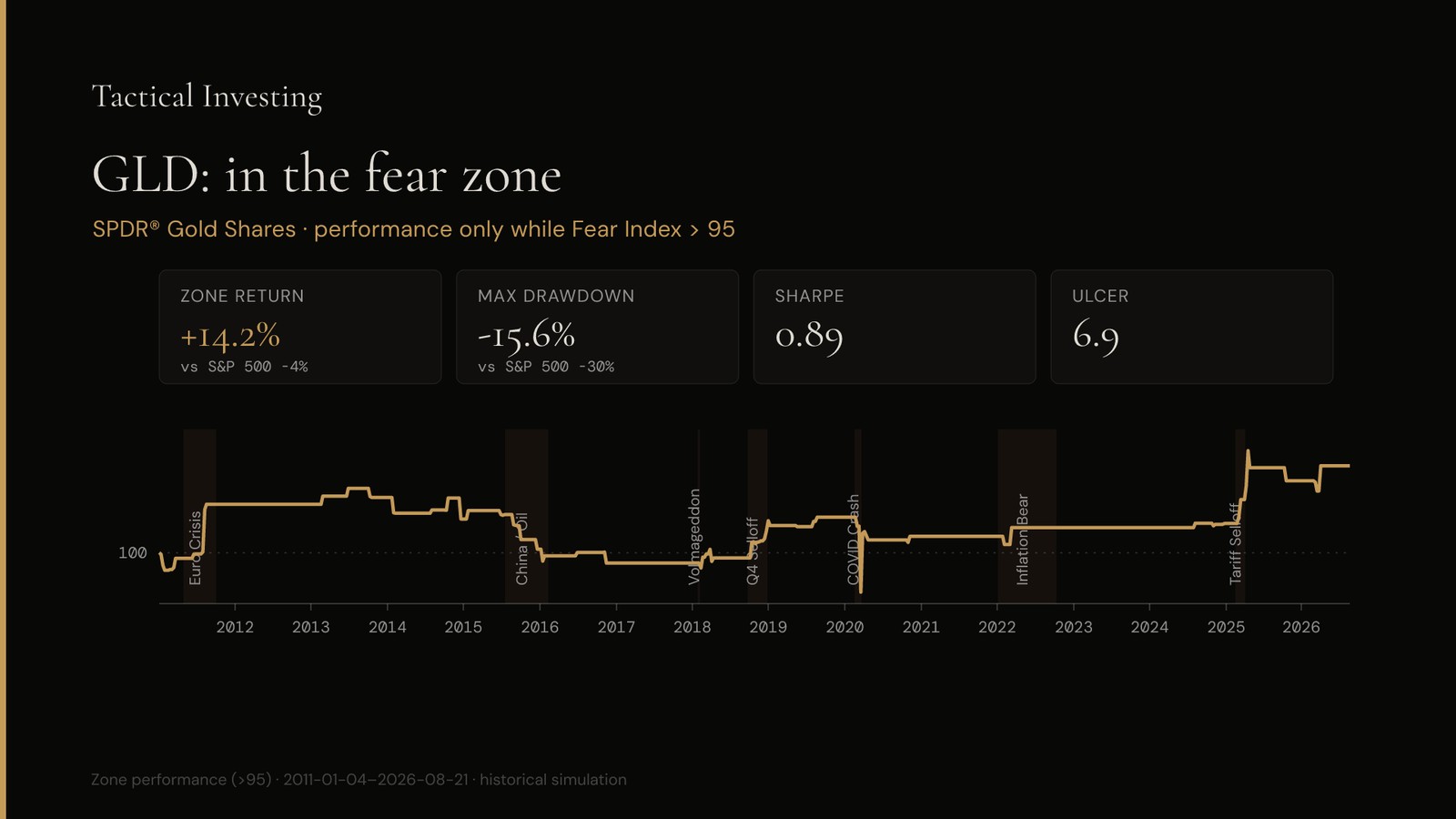
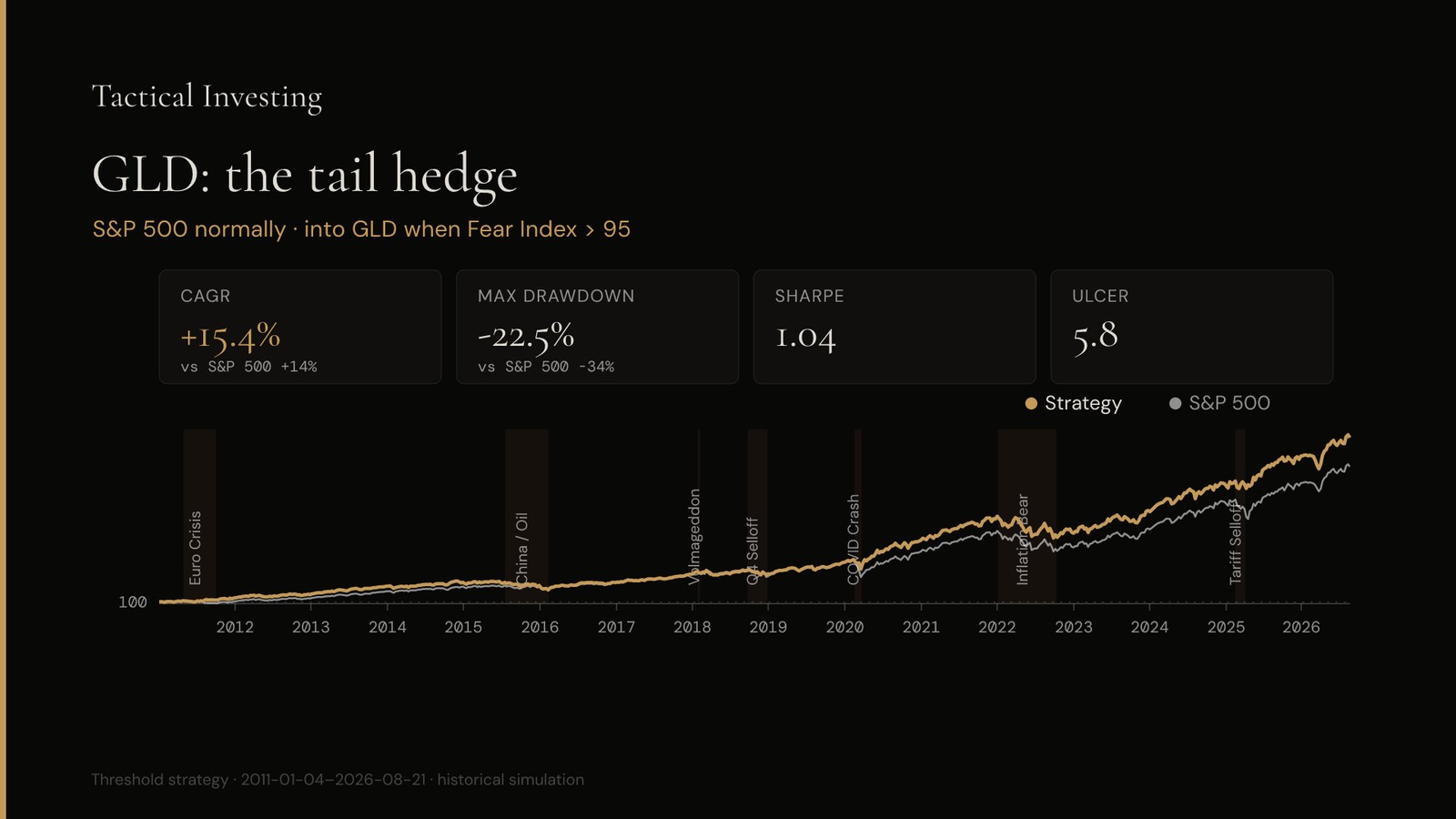
Take gold as the clearest example — and read it in two steps.
Step 1 — in the fear zone. What gold itself did on the extreme-fear days: +14.2% while the S&P slipped, with only a −15.6% wobble. That is exactly the number you’ll find in the table below.
Step 2 — the full strategy. Fold that into the rule — hold the S&P, switch to gold only at extreme fear — and it quietly beats simply holding on: more return, a shallower worst-case (gold line vs. grey).
The volatility funds — a twist worth the whole video
There’s one class that looks like the ultimate crash hedge: volatility funds. On paper they explode when markets panic. But timing is everything. Look them up in the table: short-term VIXY actually lost 8% across the fear days — by the time you flee at the standard extreme-fear level, you’ve bought the collapse.
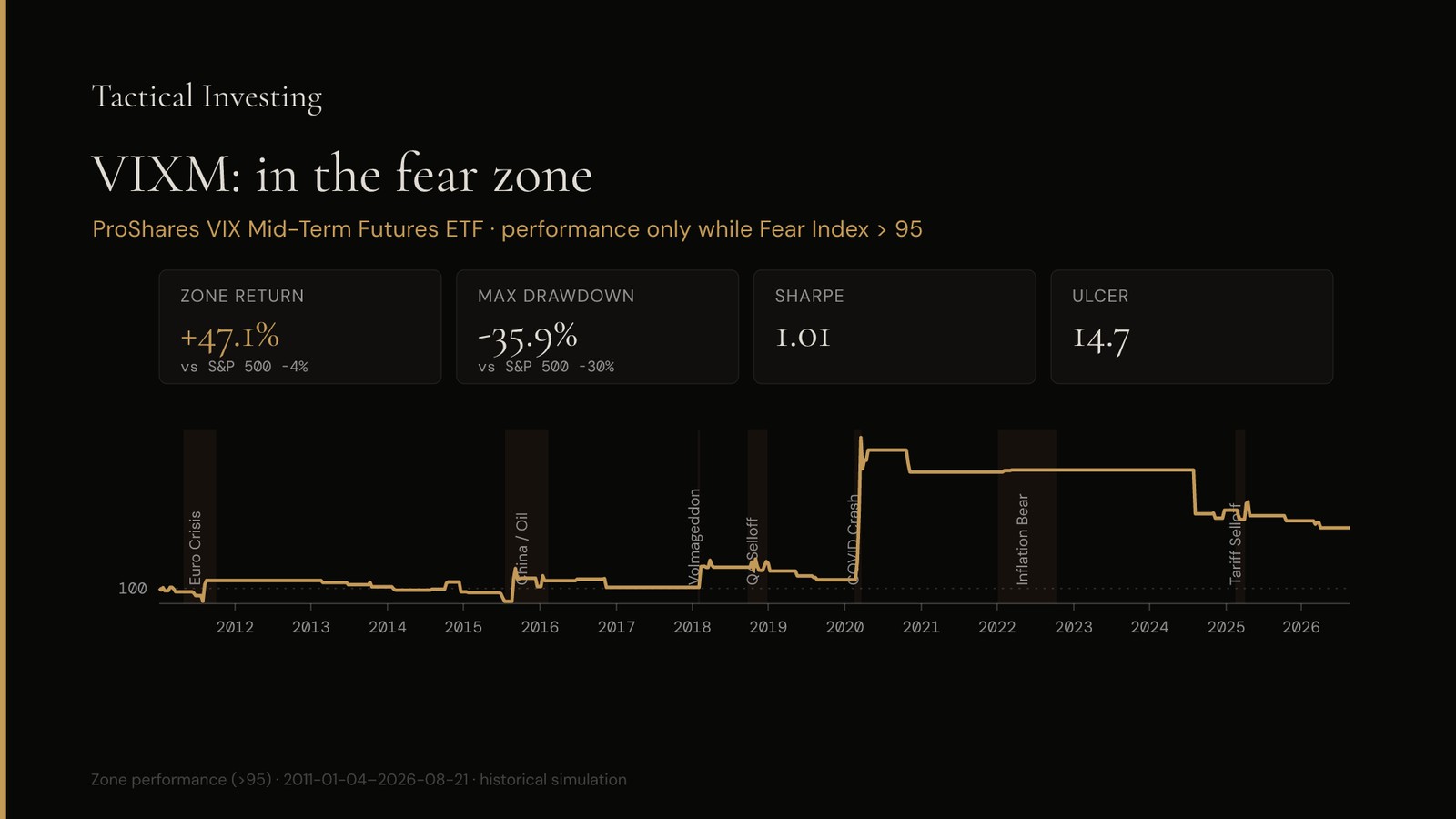
Mid-term volatility is the exception: VIXM rose +47% in those same days — though with a stomach-churning −36% swing along the way. And push the trigger to true capitulation — the very top of the fear scale, above 97.5 of 100 — and even the short-term funds flip from trap into one of the best crash assets there is.
VIXM in the fear zone. The dramatic one: +47.1% across the fear days — but a −35.9% swing to earn it. Enormous protection, and a wild ride.
VIXM as a strategy. Held only at extreme fear, even this volatile beast pulls the whole strategy well clear of the S&P — the gap tears open after 2020.
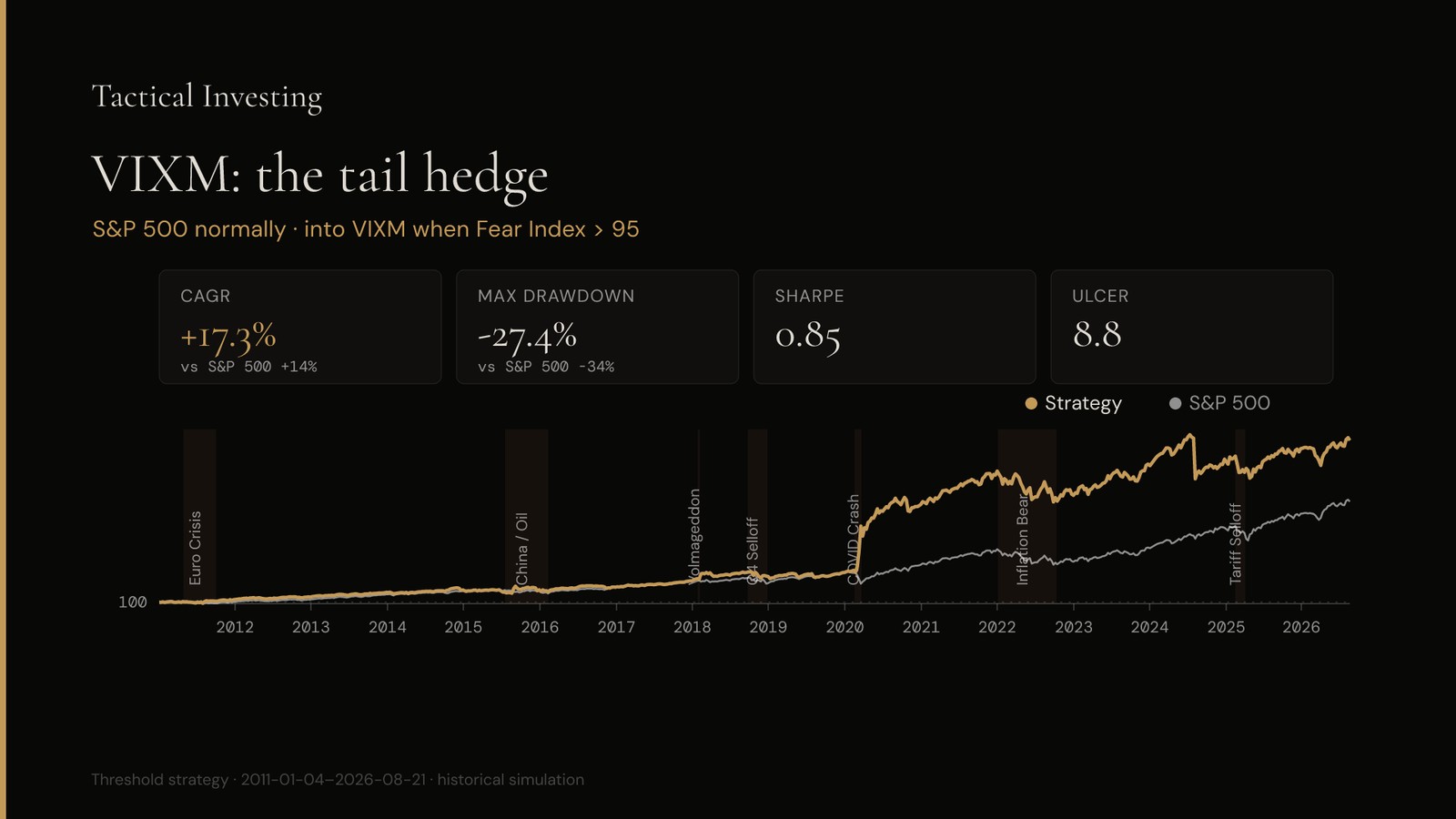
It isn’t the instrument. It’s the timing — and having a tool that gets the timing right.
No single hero — and a rule for the storm
No haven wins every crash. In 2022, long government bonds — the textbook safe bet — fell with stocks. Which is the real answer: not one fund, but a mix, so when one lets you down another holds. And you stay flexible — what worked last cycle may need swapping when the world changes.
If I had to compress fifteen years of crashes into one honest takeaway — and I’ll be careful, because this only looked at the extreme tail: boring wins. Short government bonds, cash, gold. A small, well-timed slice of volatility. What to avoid: “defensive” stocks, dividend funds, and above all leverage. Plan it calmly, in advance, because in real fear your emotions will be screaming.
Every fund I tested — search yours
One honest note before the table. Read both numbers, not one. Performance is what the fund did during the extreme-fear days; Max DD is how far it fell within them. A haven doesn’t have to leap — cash barely moves, at about +1% — it just has to spare you the worst of the drop. The safest names often rise the least, but they fall the least too; the dangerous ones cut both ways.
Why measure it at all
Ask an AI on its own and it just repeats the folklore — “gold is a hedge, bonds are safe.” Give it a way to measure every crash the same way, and you get the honest, reproducible answer instead — including the parts nobody likes to admit. That’s the whole idea behind this series.
Test it. Don’t trust it.
For educational purposes only — not financial advice.